
If your website gets traffic but no inquiries, it is a conversion issue, not a traffic one. Common culprits include hidden contact details, confusing layouts, slow loading speeds, and scary forms. Fix this by placing clear calls-to-action above the fold and offering quick WhatsApp buttons.
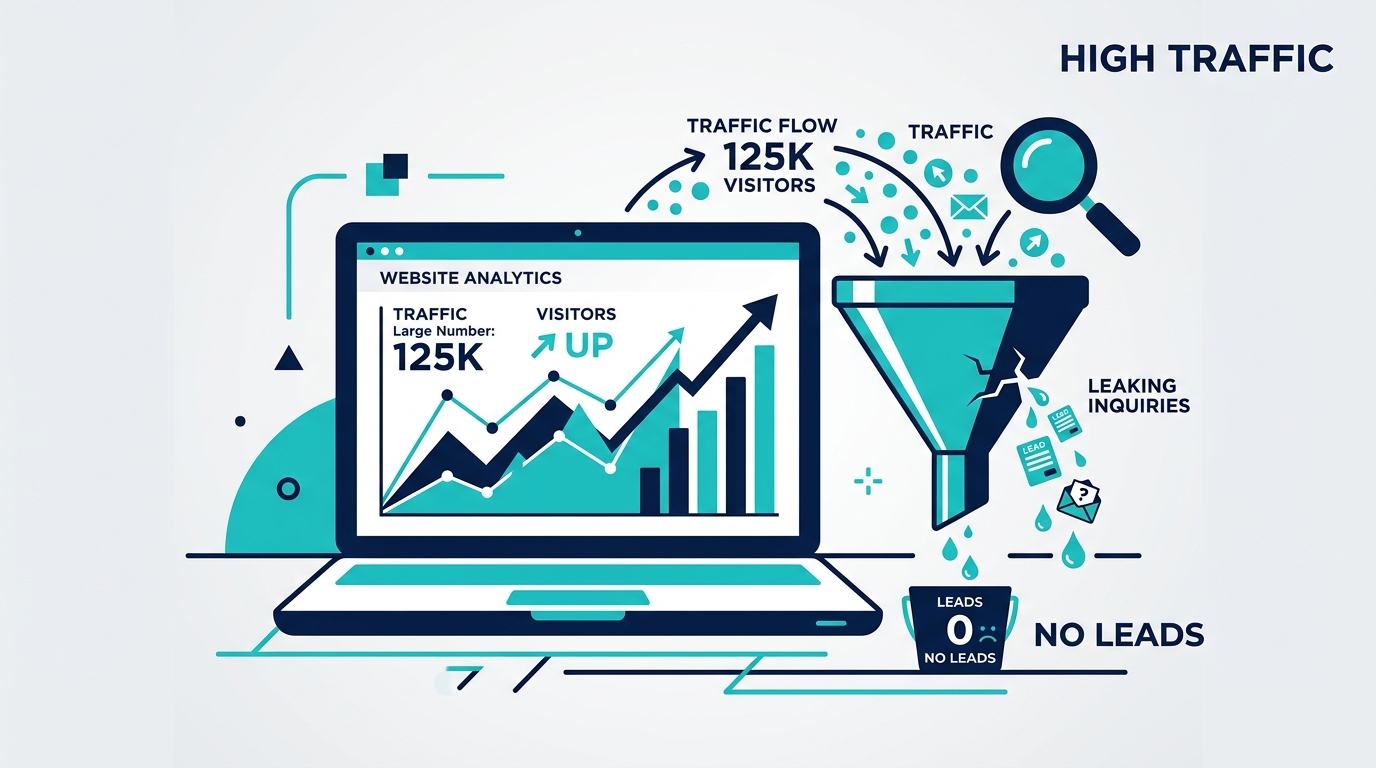
Your website is getting visitors. You can see the numbers. But your phone is not ringing and your enquiry form stays quiet. It is one of the most frustrating things a business owner can face: people are coming, but nobody is contacting you.
Here is the good news. This is not bad luck, and it is usually not a traffic problem. It is a conversion problem, and conversion problems are fixable. In most cases, a handful of small issues are quietly turning interested visitors away at the last moment.
Think of it like a shop on a busy street with plenty of people walking in, but the aisles are confusing, the prices are hidden, and the billing counter is tucked away in a dark corner. The footfall is fine. The layout is losing the sale. Let us walk through why your website is losing visitors, and how to fix each reason.
First, understand how visitors really behave
Most business owners imagine visitors read their website carefully, top to bottom. They do not. The reality is very different, and once you see it, the fixes make sense.
- About half of all visitors leave without scrolling past the first screen.
- Only a small share ever read down to the middle of a page.
- Visitors decide in about 5 seconds whether to stay or leave.
- More than 75% of Indian visitors are on a mobile phone, often on a 4G connection.
So your website has roughly 5 seconds, on a small screen, to make a distracted visitor stay. If it fails that test, nothing else on the page matters. With that in mind, here are the real reasons enquiries are not coming.
Reason 1: Your first screen does not say what you do, fast
When someone lands on your site, they silently ask: "Am I in the right place? Can these people help me?" If your first screen shows only your business name, a generic "Welcome to our website," or a pretty stock photo with no clear message, the visitor cannot answer that question. So they leave.
The fix: In your first screen, state clearly what you do, who you help, and what to do next. "Same-day dental appointments in Chennai, book now" beats "Welcome to Sharma Dental Care" every time. Clarity always wins over clever.
Reason 2: Your website is too slow
Speed is not a technical detail. It is money. Every extra second your page takes to load, more visitors give up and leave, especially on mobile. A page that takes 6 seconds on a phone has lost a large share of its visitors before they even see it.
The fix: Compress heavy images, remove unnecessary plugins and scripts, and aim to load in under 3 seconds on a mobile connection. This one change alone can noticeably lift enquiries. We once helped a clinic go from a 7-second load to just over 2 seconds, and their appointment enquiries rose 38% the next month (check out this and other results in our case studies), with the same traffic. Speeding up is key to a mobile-first site.
Reason 3: Visitors do not know what to do next
Imagine walking into a shop, deciding you want to buy, and finding no counter and no staff. That is what a website with no clear next step feels like. If a visitor has to hunt for how to contact you, most will not bother.
The fix: Put a clear, obvious button on every screen that tells the visitor exactly what happens next. "Book My Free Consultation" or "Get My Free Quote" works far better than a vague "Submit" or a small "Contact Us" link hidden in the corner. Tell them the next step, and make it easy to take.
Reason 4: Your enquiry form scares people off
Forms are where enquiries are won or lost. Many Indian business websites ask for too much, too soon: name, email, address, budget, detailed requirements, all before the visitor trusts you. Faced with a long form, most people quietly close the tab.
The fix: Keep your form short: name, mobile number, what they need, and maybe a preferred time. Four fields is plenty to start a conversation. The goal of the form is to begin a chat, not to collect their life story.
Reason 5: There is nothing that removes fear before they contact you
In India especially, visitors hesitate to share their mobile number because they fear endless spam calls. If your form gives no reassurance, that fear alone stops many people from submitting.
The fix: Add a short, reassuring line near your button. Something like "We reply within a few hours. No spam, no repeated calls." A single honest line like this can meaningfully increase the number of people who contact you, because it removes the exact fear holding them back.
Reason 6: There is no proof that others trust you
A visitor who is unsure about contacting you is really asking, "Have other people like me trusted this business and been happy?" If your website shows no reviews, no ratings, and no real testimonials, that doubt goes unanswered, and doubt kills enquiries.
The fix: Show your Google rating and real reviews, ideally with a name and city ("Priya S., Chennai"). And place your best review right next to your enquiry button, not just in the footer. Proof works hardest exactly where hesitation is highest: at the moment of deciding to contact you.
Reason 7: It looks wrong or breaks on mobile
Since most of your visitors are on a phone, a website that looks good on a computer but is clumsy on mobile is losing most of its audience. Tiny text, buttons too small to tap, and layouts that jump around all push mobile visitors away.
The fix: Make sure your website is built mobile-first: easy to read, easy to tap, and smooth on a phone. If booking or calling you on a mobile is not effortless, you are leaving enquiries on the table every single day.
The pattern behind all of this
Notice something: none of these fixes are about getting more visitors. They are about losing fewer of the visitors you already have. This is what conversion is. Most businesses assume the answer is more traffic or more ad spend. Very often, the cheaper and faster win is simply to stop leaking the visitors already arriving.
Fixing these issues means every rupee you spend on ads or SEO works harder, because more of the people it brings actually become customers.